
CT Scan vs MRI Full Body: Which Screening Is Right for You?
If you’re comparing a CT scan vs MRI full body screening, here’s the direct answer: for whole-body preventive screening without radiation exposure, MRI is the stronger option. CT scans deliver superior results for specific targets like coronary calcium scoring and lung cancer detection – but when the goal is a single, radiation-free scan covering your organs, brain, soft tissue, and musculoskeletal system together, whole-body MRI gives you more complete information.
Both technologies are genuinely impressive. Both catch things that would otherwise go undetected for years. But they are not interchangeable, and for someone who wants a real, head-to-toe picture of what’s happening inside their body, the differences between them are worth knowing.
At Craft Body Scan, we work with patients every week who come in after spending hours online trying to sort through conflicting information about full body CT or MRI options. Some have seen ads for full body CT scans. Others have heard that MRI is superior but weren’t sure why. This article cuts through the noise and gives you a clear, side-by-side comparison – so you can make a decision based on evidence, not guesswork.
from a full body CT scan
a whole-body MRI
in a single full body CT
What Each Technology Actually Does
Before comparing a full body CT or MRI head-to-head, it helps to understand what each machine is doing when you lie down inside it.
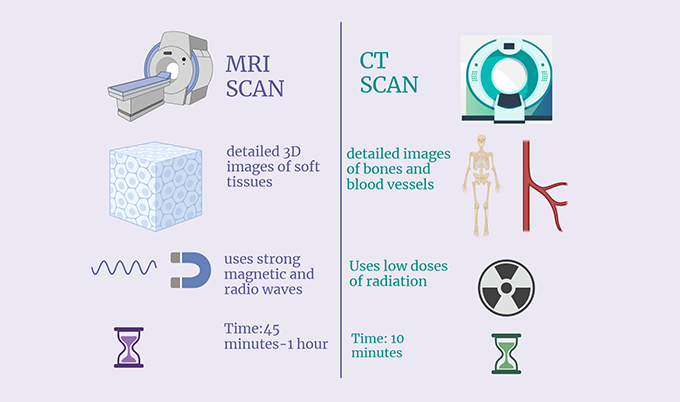
A CT scan – short for computed tomography – uses X-rays. The machine rotates around your body and captures hundreds of cross-sectional images, which a computer assembles into detailed slices of your internal anatomy. CT is extraordinarily fast – a full body CT scan completes in a matter of minutes. That speed makes it the go-to tool in emergency settings and for imaging structures where density contrast matters most, like bones, calcified plaques in arteries, and dense tissue masses.
MRI – magnetic resonance imaging – works on a fundamentally different principle. It uses powerful magnetic fields and radio waves to create detailed images by measuring how hydrogen atoms in your body respond to those fields. No radiation involved. MRI produces rich, high-contrast images of soft tissue – organs, muscles, ligaments, the brain, the spine, and early-stage abnormalities that a CT scan may miss entirely.
Both produce images. Both detect disease. But the types of tissue they see most clearly, and the health implications of using them repeatedly, are not the same.
The Radiation Question in CT Scan vs MRI Full Body Comparisons
This is one of the most important differences between these two technologies – and it’s often undersold in casual comparisons.
A full body CT scan delivers a meaningful dose of ionizing radiation. A typical full body CT scan exposes a patient to somewhere between 10 and 20 millisieverts (mSv) of radiation. For context, the average American receives about 3 mSv per year from natural background sources. A single full body CT scan can represent five to seven years’ worth of that baseline exposure in one appointment.
That doesn’t make CT scans dangerous for patients who need them. It does, however, make them a real consideration for preventive screening – especially if you plan to get scanned annually or every few years as part of a proactive health routine.
MRI uses no ionizing radiation whatsoever. The magnetic fields and radio waves used in MRI have no known cumulative health risk. For a healthy adult who wants repeated full body screening over time, that’s a significant advantage. You can return for annual whole-body MRI screening without adding to a lifetime radiation burden.
This distinction matters especially for younger patients, women, and anyone with a family history that makes regular monitoring important for years to come.
Where CT Scans Outperform MRI

A fair CT scan vs MRI full body comparison requires honesty about where each technology genuinely excels. CT scans are not inferior tools – they’re the right tools for specific jobs.
CT imaging is the gold standard for detecting coronary artery calcium, which is why our Heart Scan service uses CT technology. Calcium deposits in the arteries show up with exceptional clarity on CT, and the coronary calcium score derived from this scan is one of the most reliable predictors of cardiovascular risk available.
CT is also the preferred technology for lung cancer screening. According to the American Cancer Society, low-dose CT scans are recommended for high-risk individuals because they detect small pulmonary nodules far earlier than any other imaging method.
CT also excels at imaging:
- Bone fractures and skeletal abnormalities – CT captures mineralized structures with unmatched detail
- Acute abdominal emergencies – Speed and accessibility make CT essential in urgent care
- Vascular calcification and stenosis – Dense deposits in arterial walls appear clearly
- Kidney stones and urinary tract obstruction – Small calcified stones are reliably detected
For these specific applications, CT isn’t just adequate – it’s the preferred clinical choice.
| Feature | Full Body CT Scan | Whole-Body MRI |
|---|---|---|
| Radiation Exposure | 10-20 mSv (significant) | None ✓ |
| Soft Tissue Detail | Moderate | Superior ✓ |
| Bone & Calcification | Superior ✓ | Moderate |
| Brain Imaging | Limited | Gold standard ✓ |
| Coronary Calcium Score | Gold standard ✓ | Not used for this |
| Lung Cancer Screening | Recommended ✓ | Not primary choice |
| Scan Duration | 10-15 minutes ✓ | 60-90 minutes |
| Safe for Repeat Screening | Limited (radiation accumulates) | Yes, no limits ✓ |
| Early Cancer Detection | Good for dense structures | Excellent for soft tissue ✓ |
Where MRI Outperforms CT for Full Body CT or MRI Screening
When the goal shifts from imaging one specific structure to getting a whole-body picture of organ health – and doing it without radiation – MRI holds clear advantages.
Soft tissue is where MRI separates itself. The liver, kidneys, pancreas, spleen, adrenal glands, lymph nodes, and pelvic organs all appear with far greater contrast resolution on MRI than on CT. Many early-stage cancers and benign masses that would appear subtle or invisible on CT are visible on MRI precisely because of that soft tissue differentiation.
The brain is perhaps the clearest example. MRI is the standard of care for brain imaging – not CT. Early white matter changes, small lesions, early signs of neurodegenerative conditions, and vascular abnormalities like aneurysms are all more reliably detected on MRI.
Whole-body MRI is also the preferred modality for:
- Detecting early-stage cancer across multiple organ systems in a single scan session
- Evaluating the musculoskeletal system – cartilage, ligaments, spinal discs, and soft tissue tumors
- Identifying early bone marrow changes that may signal blood cancers or metastatic spread
- Assessing the liver and pancreas for lesions, cysts, and early fibrosis
- Prostate and pelvic organ evaluation – areas where MRI’s soft tissue detail is definitive
For a patient who wants one scan to cover as much internal ground as possible – without radiation exposure – whole-body MRI is the stronger platform.
The Speed Trade-Off: Is a Longer Scan Worth It?
One honest trade-off worth naming in any full body CT or MRI comparison: MRI takes longer. A full body CT scan might take 10-15 minutes. A whole-body MRI typically runs 60 to 90 minutes, depending on the protocol and how many regions are being imaged.
For some patients, particularly those with claustrophobia or difficulty lying still, that’s a real consideration. Modern MRI scanners have wider bores and quieter operation than older equipment, and most patients move through the exam without difficulty.
For an elective, proactive screening appointment scheduled at a time of your choosing, the time difference becomes less of a barrier. The question to ask yourself: would you rather spend 15 minutes getting a faster scan with radiation exposure, or 75 minutes getting a more detailed scan without it? For most healthy adults pursuing preventive screening, the answer points toward MRI.
Who Should Choose a Full Body CT Scan vs Whole-Body MRI?
Rather than declaring one technology universally superior, the more useful question is: which is right for your specific situation?
A full body CT scan – or targeted CT scans like our Heart Scan or Lung Scan – may be the better starting point if:
- You have specific cardiovascular risk factors and want a coronary calcium score to quantify arterial plaque buildup
- You are a current or former smoker who meets the age and history criteria for low-dose CT lung cancer screening
- You need a fast initial screening and prefer to start with a targeted, lower-cost scan
- Your physician has recommended CT for a specific clinical concern
A whole-body MRI is likely the stronger choice if:
- You want full organ screening in one session without radiation exposure
- You plan to screen annually or every two years and want to avoid cumulative radiation over time
- You have a family history of cancer or organ disease and want sensitive early detection across multiple systems
- You’ve already had CT-based cardiac and lung scans and want to extend screening to soft tissue and organ health
- You want the most detailed view of brain, liver, kidneys, lymph nodes, and musculoskeletal structures available in a non-invasive context
Some patients use both strategically – a targeted heart scan or lung scan using CT for those specific indications, paired with whole-body MRI for everything else. That combination approach gives you the best of both technologies while keeping radiation limited to the scans where CT is genuinely the right tool.
✓ Whole-Body MRI Checklist: Is It Right for You?
- Age 40 or older with no current symptoms
- Family history of cancer, heart disease, or organ disease
- Want radiation-free screening you can repeat annually
- Interested in one scan covering brain, organs, and musculoskeletal system
- Already completed a heart or lung CT scan and want broader coverage
- Proactive about health and want a baseline internal picture
What a Whole-Body MRI at Craft Body Scan Includes
One of the most common questions we hear about the CT scan vs MRI full body decision is: what does a whole-body MRI actually cover? It’s a fair question, because “full body” can mean different things depending on the provider and protocol.
Our Whole-Body MRI screening images multiple organ systems in a single session – typically including the brain, spine, thoracic organs, abdominal organs (liver, kidneys, pancreas, spleen, adrenal glands), pelvic organs, and musculoskeletal structures. Every scan is reviewed by a board-certified radiologist, and findings are communicated clearly – not just as a dense radiology report, but with context you can actually act on.
Our team follows up on any detected abnormalities and can help coordinate next steps with your primary care physician or specialist. You don’t receive a scan result and then get left to interpret it alone.
CT Scan vs MRI Full Body: Making the Right Choice for Your Health
There is no single answer that applies to every person. But clear patterns point toward better choices for different goals.
If you are a healthy adult pursuing proactive, preventive screening – someone who wants to know what’s happening across their entire body before symptoms appear – whole-body MRI is the more complete tool. It covers more ground, produces richer soft tissue detail, spares you radiation exposure, and suits repeat screening over time.
CT scans remain excellent for targeted applications: coronary calcium scoring, lung cancer screening, and other specific indications where CT’s speed and density resolution are genuinely superior. Many patients use both – and that’s a smart approach.
The goal of any full body screening is simple: find what might hurt you before it gets the chance. Whether you’re weighing a full body CT or MRI, let your risk profile, screening history, and health goals lead the decision – not marketing or price alone.
If you’re ready to take that step, our team at Craft Body Scan can walk you through which screening combination makes the most sense for your age, history, and health goals.