Medical Disclaimer: This content is for educational purposes only and does not constitute medical advice. Consult your physician before making any healthcare decisions.
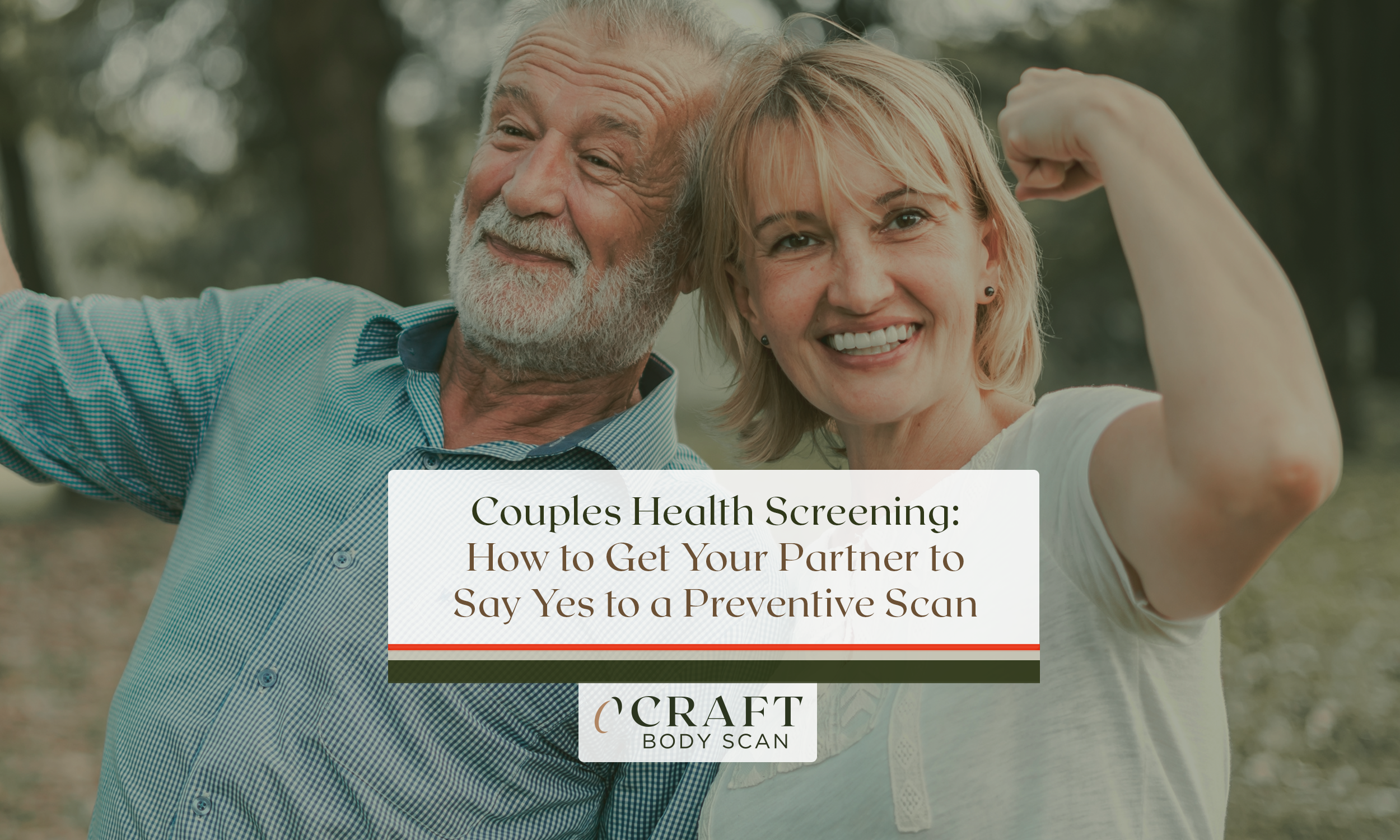
You have probably already had the conversation. Maybe more than once. You bring up the idea of a preventive body scan and your partner shrugs it off, says they feel fine, or finds a reason to change the subject. You are not alone. Couples health screening is one of those decisions where one partner is almost always driving the conversation – and running into a wall.
The resistance is real, it is common, and it has a predictable shape. Understanding why it happens – and what actually moves people from “I’m fine” to “let’s book it” – makes all the difference. This article lays out exactly that, along with the specific reasons the $149 Craft Body Scan couples Heart and Lung Scan removes every major barrier that typically kills this conversation.
1. Why the Resistance Happens – and Why It Is Not About Health
If your partner is resistant to a preventive scan, the most common reason is not that they actually believe they are healthy. It is that getting scanned makes the possibility of finding something real. Right now, feeling fine means everything is probably fine. A scan changes that equation – and that is uncomfortable.
The data backs this up. A 2025 Aflac survey of 2,000 U.S. adults found that 90% of Americans have put off a recommended health screening (Aflac Wellness Matters Survey, 2025). Among the reasons cited: fear of bad news, inconvenience, and a general dislike of doctor visits. Crucially, 62% of people who believed they were likely to receive a cancer diagnosis in their lifetime had still skipped screenings. Knowing you should go does not get you through the door.
Men, specifically, carry a distinct pattern. According to a Harris Poll conducted for Orlando Health, one-third of men say they do not think they need annual health screenings at all, and 65% believe they are naturally healthier than others (Medical News Today, 2022). A Cleveland Clinic survey found that only 50% of men consider an annual check-up a regular part of self-care. And yet the same survey showed that 82% of men say they try to stay healthy specifically for their families – the people who rely on them (Cleveland Clinic MENtion It Survey).
That gap – wanting to be healthy for family and avoiding the one thing that tells you whether you are – is the core tension you are working with. Your job is not to win an argument. It is to close that gap.
2. The Health Disparity Gap That Couples Health Screening Directly Addresses
Gender health disparities in preventive care are well-documented and consequential. Men in the United States die an average of five years earlier than women (Medical News Today, citing National Vital Statistics Reports). Heart disease and cancer are the two leading causes of death among men. Nearly 52% of men aged 20 and older have high blood pressure or are taking medication for it – a major risk factor for both heart attack and stroke that often produces no symptoms until damage has already occurred.
The preventive care gap is not a small one. While women are significantly more likely to schedule annual wellness visits, routine screenings, and follow up on abnormal findings, men consistently deprioritize that same care. The Cleveland Clinic’s research found that 61% of men said they would be more likely to go to their annual check-up if it were simply more convenient. The barrier is not opposition to health – it is friction.
This is exactly where a couples health screening changes the dynamic. When both partners go together, the social and logistical friction disappears. The appointment is shared, the accountability is mutual, and the emotional weight of “going to get checked” is distributed across two people rather than carried by one. The Aflac 2025 survey found that 73% of Americans feel grateful when a loved one urges them toward preventive care – and that those who book appointments together are twice as likely to follow through compared to those who plan to go alone.
Booking a preventive scan for couples is not just a practical health decision. It reframes the conversation from “you need to go get checked” to “we are doing this together.”
| Component | What It Screens | Per Person |
|---|---|---|
| Coronary Calcium Score CT | Coronary artery plaque buildup — detects heart disease risk 5-10 years before a cardiac event | Both partners |
| Low-Dose Chest CT | Lung nodules, masses, and abnormalities — reduces lung cancer mortality by 20% vs. chest X-ray | Both partners |
| Board-Certified Radiologist Review | Every scan read with secondary provider quality check — results within 5-10 business days | Both partners |
| 90-Minute Health Consultation | Findings review, context, and recommended next steps — not just a report in a portal | Included |
No physician referral or insurance authorization required. Total price: $149 for both partners. Source: craftbodyscan.com/heart-lung-scan
3. The $149 Couples Heart and Lung Scan: What It Covers and Why It Changes the Conversation
One of the most consistent barriers to preventive health screening is cost. Hospital-based CT imaging typically runs $2,500 to $5,000 for a full body scan. That price point is enough to end the conversation before it starts for most couples, regardless of how motivated one partner might be.
The Craft Body Scan couples Heart and Lung Scan at $149 is specifically designed to remove that barrier. For $149 total, both partners receive:
- A Coronary Calcium Score CT – the most direct measure of coronary artery plaque buildup available without a hospital referral. A score above zero indicates calcified plaque is present; a high score indicates significant plaque that warrants medical attention. This test can identify heart disease risk 5-10 years before a cardiac event.
- A Low-Dose Chest CT – screening the lungs for nodules, masses, and abnormalities that are often silent in early stages. The American Cancer Society notes that low-dose CT lung screening cuts lung cancer mortality among high-risk adults by 20% compared to standard chest X-rays.
- Board-certified radiologist review – every scan at every Craft Body Scan clinic is read by a board-certified radiologist with a secondary provider quality check. Results are delivered within 5-10 business days through the patient portal.
- A 90-minute health consultation – a conversation about findings, context, and recommended next steps. Not just a report dropped into a portal with no follow-up.
The $149 price covers both partners. No physician referral. No insurance authorization. Two separate scans, two sets of results, two board-certified radiologist reports – for less than a single tank of gas per person.
That number changes the conversation. “We should get scanned” is abstract. “It is $149 for both of us and takes under an hour” is a specific, answerable proposition. Learn more about the couples Heart and Lung Scan and what it detects.
4. Five Arguments That Actually Work (And How to Use Them)
Most couples who have tried this conversation know that leading with “you should take better care of yourself” does not land well. The arguments that move resistant partners are specific, concrete, and framed around the right emotional register. Here are five that consistently work.
| Statistic | Finding | Source |
|---|---|---|
| Americans who've skipped a recommended screening | 90% | Aflac, 2025 |
| Men who don't think they need annual screenings | 1 in 3 | Harris Poll / Orlando Health |
| Men motivated by family longevity to stay healthy | 82% | Cleveland Clinic MENtion It Survey |
| Men who'd go if it were more convenient | 61% | Cleveland Clinic |
| More likely to follow through when booking together | 2x more likely | Aflac, 2025 |
| Americans grateful when a loved one urges preventive care | 73% | Aflac, 2025 |
Sources: Aflac Wellness Matters Survey 2025; Cleveland Clinic MENtion It Survey; Harris Poll / Orlando Health via Medical News Today 2022
- “Heart disease has no symptoms until it does.” Coronary artery disease, the leading cause of heart attacks, builds plaque in the arteries for years without producing pain, fatigue, or any warning. A coronary calcium score does not diagnose heart disease – it measures how much plaque is already there, right now. You cannot know that number from how you feel. This argument works because it is factual, not alarmist.
- “It is 10 minutes out of your morning.” The Cleveland Clinic found that 61% of men who resist annual check-ups say they would go if it were more convenient. A CT scan at Craft Body Scan takes under 10 minutes. No needles, no fasting, no long hospital waits. The time barrier is not real here, and naming that directly often breaks the excuse cycle.
- “Our kids need you healthy at 70, not just now.” The same Cleveland Clinic research shows 82% of men are motivated by family longevity – staying healthy for the people who rely on them. That motivation is already present. The conversation just needs to connect it to a specific action rather than leaving it abstract.
- “If it comes back clear, we have documented proof you are healthy.” A normal result is not a wasted appointment. It is a baseline on file – a documented coronary calcium score of zero, clear lungs, no suspicious findings. That is information that has value in every future medical conversation. Framing the scan as data collection rather than illness-seeking shifts the emotional weight entirely.
- “It is $74.50 each. Less than our last dinner out.” Price resistance evaporates when the number is specific and contextualized. $149 for two people, compared to what it would cost through a hospital system, compared to what couples routinely spend on things with far less long-term value – that comparison is not an argument, it is just arithmetic.
5. What Happens After a Couples Scan – and Why the Follow-Through Matters
The Aflac 2025 data contained one finding that cuts through everything else: Americans who book health appointments together at a specific time of year are twice as likely to follow through compared to those who plan to go alone. The accountability structure of going as a couple is not incidental to preventive health screening – it is a core driver of whether it actually happens.
After a Craft Body Scan couples Heart and Lung Scan, each partner receives individual results reviewed by board-certified radiologists. The findings fall into a few categories:
- No significant findings – the result most people receive. This is documented evidence of cardiovascular and pulmonary health at this point in time, useful as a baseline going forward.
- Findings that warrant monitoring – a coronary calcium score in an elevated range, a small lung nodule flagged for annual follow-up, a minor vascular finding. These results go back to your primary care physician with the radiologist’s report, allowing them to add monitoring to your care plan before anything becomes urgent.
- Findings that require action – a small percentage of scans reveal something that needs prompt follow-up. Craft Body Scan’s own data across all clinic locations shows that 43% of scans reveal early signs of disease in patients who had no indication anything was developing. When a finding like this surfaces in a couple’s scan, the shared appointment structure means both partners are already in the loop, both have their own clinical data, and follow-up decisions are made together.
That last scenario – finding something significant before symptoms appear – is the entire point of preventive scanning. Early-stage colorectal cancer has a 91.5% five-year survival rate. Found at a distant stage, that figure drops to 14.7% (NCI SEER). Lung cancer caught while localized carries approximately a 67% five-year survival rate. At a distant stage – which happens in a large share of cases – that rate falls near 12% (American Lung Association). These are not marginal differences – they are outcomes that hinge entirely on when the condition was found.
The couples health screening conversation is ultimately about this: the version of events where something is found early is better than any version where it is found late. That truth does not require a hard sell. It requires one decision to book the appointment. Explore the full range of Craft Body Scan services available at every clinic location.
Schedule your Craft Body Scan today
Frequently Asked Questions About Couples Health Screening
What is a couples health screening?
A couples health screening is a preventive medical scan that both partners complete together, typically at the same appointment. At Craft Body Scan, the $149 couples Heart and Lung Scan includes a coronary calcium score CT and a low-dose lung CT for each partner – reviewed by board-certified radiologists – with results delivered within 5-10 business days. No physician referral or insurance authorization is required.
Why is booking a preventive scan as a couple more effective?
Research shows that Americans who book health appointments together are twice as likely to follow through compared to those planning to go alone (Aflac, 2025). Shared accountability reduces the logistical and emotional friction that causes individual partners to repeatedly delay. It also reframes the conversation from “you need this” to “we are doing this together,” which changes the social dynamic entirely.
What does the $149 couples Heart and Lung Scan include?
Both partners receive a Coronary Calcium Score CT and a low-dose Chest CT. Every scan is reviewed by board-certified radiologists with a secondary quality check. Results arrive within 5-10 business days through the Craft Medical Records System portal. A 90-minute health consultation is included. Learn more at the Heart and Lung Scan page.
Does my partner need a physician referral to get a preventive body scan?
No. Craft Body Scan operates as a direct-to-consumer screening center at all locations. Both partners can schedule independently, without a physician order. If results indicate findings that warrant medical attention, the team recommends appropriate follow-up with your primary care provider.
What if my partner's scan finds something?
If a scan reveals a finding that requires follow-up, Craft Body Scan’s team contacts the patient directly by phone before results are posted to the portal. The radiologist’s written report can be shared with your primary care physician, who can then order additional imaging or testing. Finding a condition early – before symptoms – is the scenario where treatment works best and survival rates are highest.
Are preventive scans covered by insurance?
Most preventive CT screenings are not covered by standard insurance unless ordered for a specific clinical reason by a physician. The $149 couples scan is a direct-pay price that requires no insurance filing. Individual full body scans at Craft Body Scan start at $2,495, with payment plans available at all locations. Find your nearest Craft Body Scan location.
The Conversation Worth Having Once
Couples health screening works because the hardest part is not the scan itself - it is getting both people to the appointment. Every argument listed in this article is a real one, backed by real data. Every barrier that stops most couples - cost, inconvenience, fear, and the feeling that everything is probably fine - is directly addressed by the Craft Body Scan $149 couples offer.
Across all Craft Body Scan clinic locations, 43% of scans reveal early signs of disease in patients who had no idea anything was developing. That figure does not mean most people are sick. It means early detection is doing exactly what it is supposed to do - finding conditions before they produce symptoms, while the window for intervention is still open.
One conversation. One appointment. Under 10 minutes each.
Book your couples Heart and Lung Scan today at craftbodyscan.com or call your nearest clinic location. Both partners, one price, results in hand within two weeks.