

Medical note. This article is for education only. Use your clinician for personal medical advice. If you have health concerns, an implanted device, or a pregnancy, talk with your doctor before you schedule imaging.
If you typed “whole body MRI what to expect” because the machine, noise, or prep has you hesitating, you’re asking the questions we hear every week. You want to know if it hurts, what clothes work, and how long the scanner part lasts. The good news is that the answers are easier than the search results make them feel.

During the scan, you lie on a padded table while the MRI maps soft tissues, organs, and major vessels with magnets and radio waves without ionizing radiation. Most patients are in our office for about 60 to 90 minutes from check-in to checkout. The machine is loud, and the tube can feel narrow, so we’ll cover both before you arrive.
For clinical background first, the body MRI overview from RadiologyInfo is a reliable place to start.
If you’re ready to compare preventive imaging options, the whole body MRI page has the next steps. If you want the full prep guide first, keep reading. We walk through the visit from check-in to results.
The short answer
- No ionizing radiation. A whole body MRI uses magnets and radio waves instead of X-rays.
- Prep is minimal. A light meal is usually fine beforehand. Before the scan, you change into our gown and remove anything metal.
- Expect 45 to 75 minutes inside the scanner, with total appointment time closer to 60 to 90 minutes once check-in and positioning are included.
- A board-certified radiologist reads the study. You receive a reader-friendly written report, usually within a few business days, to review with your own physician.
What a whole body MRI scan actually is
MRI means magnetic resonance imaging. Inside the scanner, a strong magnetic field and radio wave pulses affect hydrogen atoms in your body’s water molecules. Those atoms release signals as they settle back.
Those signals become high-contrast images of soft tissues, organs, blood vessels, and musculoskeletal structures. No X-rays are part of MRI, so it works well for patients avoiding ionizing radiation.
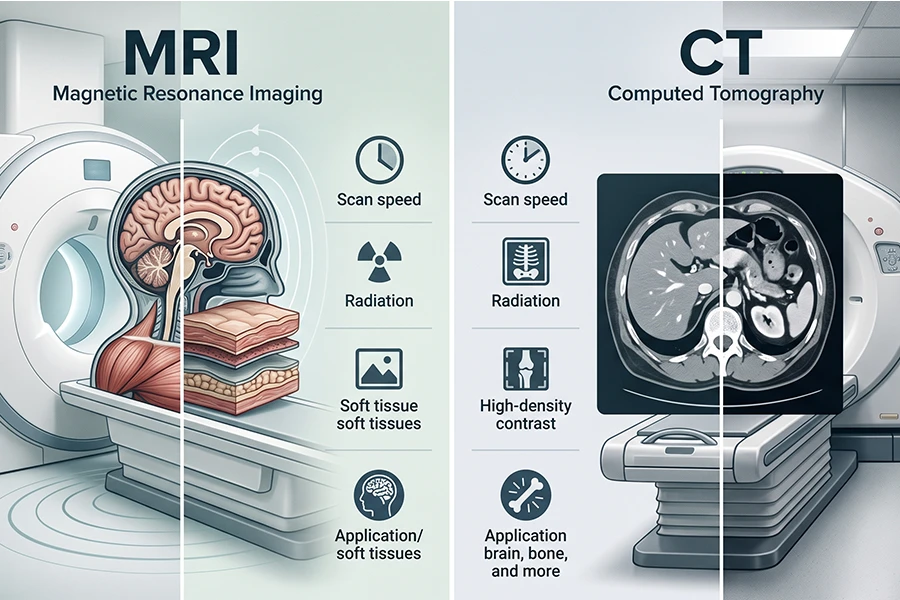
CT means computed tomography, and it creates cross-sectional images with X-rays. For calcifications, dense bone detail, trauma, and certain lung findings, CT often gives the better answer. MRI is different because its soft-tissue contrast helps separate tissues that can look similar on other scans.
That extra tissue detail helps the radiologist review the liver, kidneys, spleen, pancreas, brain, and spine. The National Institute of Biomedical Imaging and Bioengineering offers a useful primer on how MRI works at the cellular level.
| Feature | Whole Body MRI | CT Scan |
|---|---|---|
| Radiation | None | Yes, ionizing X-rays |
| Best for | Soft tissue, organs, spine, brain, vessels | Lungs, bone, calcifications, trauma |
| Scan time | 45 to 75 minutes | 10 to 30 minutes |
| Contrast dye | Sometimes (gadolinium based) | Sometimes (iodine based) |
| Claustrophobia factor | Higher (longer time in bore) | Lower (faster, more open) |
On a whole body MRI, the radiologist can see changes in the liver, kidneys, adrenal glands, spleen, pancreas, and lymph nodes. The same study can show spine changes, soft-tissue masses, and vascular concerns in major vessels. Preventive screening does not diagnose or treat a condition during the visit.
It gives your physician imaging findings that may need follow-up. Our full body scan overview compares imaging options so you can see which study fits your situation.
How to prepare for a whole body MRI
Preparation is simple. Most patients don’t need a long fast or a complex protocol. A few details matter before you arrive.
Food and drink
For most whole body MRI studies, you can eat and drink normally beforehand. A light meal is fine. If your scan includes abdominal sequences that need an empty stomach, we’ll tell you ahead of time.
You can also review our post on what to eat before a CT scan or MRI. Water and medications are usually fine to continue as normal, but list your medications when you book.
Metal and implants
The safety form matters because the MRI machine is a powerful magnet. Metal is the reason we slow down during safety screening. Certain objects or devices can move, heat up, malfunction, or blur the images.
Before your appointment, the safety questionnaire helps us check whether MRI is safe for you. A pacemaker, cochlear implant, certain aneurysm clips, or another implanted electronic device may require physician clearance before MRI. Joint replacements, dental fillings, and surgical staples usually work with MRI safety rules. List them anyway so our team can verify the details.
What to wear for a whole body MRI
We provide a gown for the scan. Before you enter the scanner room, remove jewelry, underwire bras, belt buckles, body piercings, and metal hair clips. Clothes that change easily save time. Jewelry is better left at home.
Bring a glasses case because glasses stay outside the room. Some patients can wear soft, metal-free athletic wear during the scan. Ask our team when you schedule if that’s an option for your study.
Day-of prep checklist
- →Eat normally. A light meal beforehand is fine unless we tell you otherwise.
- →Take your usual medications. Use water as normal unless your care team gives different instructions.
- →Leave jewelry at home. Rings, earrings, necklaces, bracelets, and piercings stay out of the scanner room.
- →Wear comfortable, easy-to-remove clothing. Skip underwire bras and belts with metal hardware.
- →Disclose every implant and device. Your safety form should include pacemakers, IUDs, joint replacements, and surgical hardware.
- →Arrive 15 minutes early. Your appointment window already includes paperwork, screening, and locker time.
- →Tell us about claustrophobia ahead of time. We prefer to plan comfort options before you arrive.
- →Bring a list of any current medications. This matters most when your scan uses contrast.
What happens during the scan, step by step
The visit feels less strange when you know the order of events.
Arrival and check-in
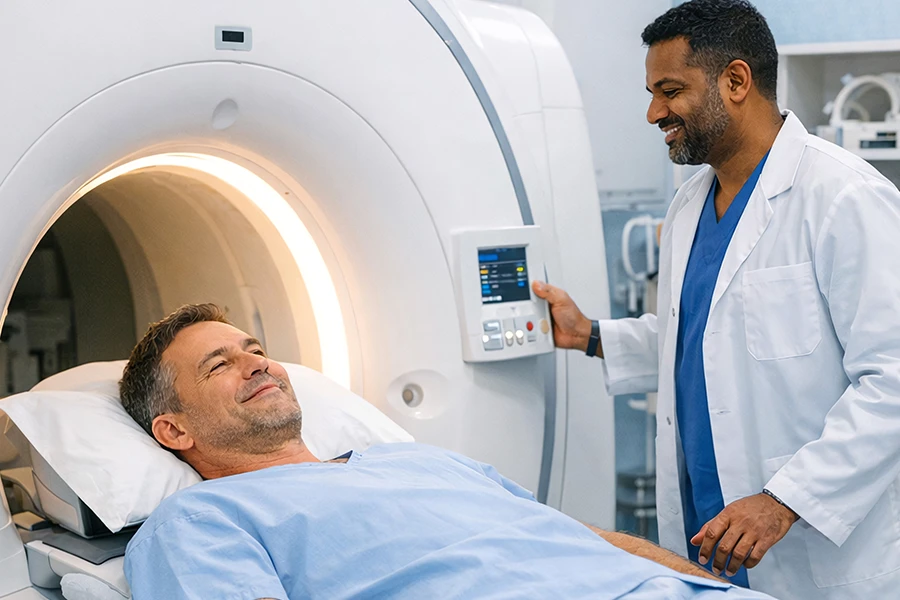
When you arrive, you finish the safety form and check in. A technologist reviews the form with you, then checks details about implants, allergies, and prior imaging. Then you change into your gown and put your belongings in a locker. Check-in usually takes 10 to 15 minutes, assuming the safety form is complete.
Positioning on the table
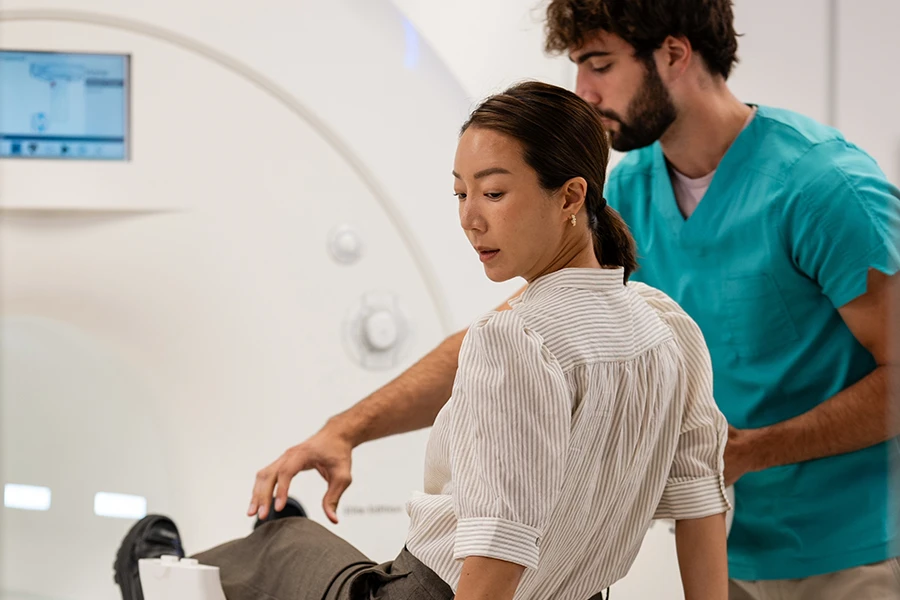
The padded MRI table moves slowly into the bore of the machine. You lie flat on your back for the scan. The technologist may place flexible padded panels called surface coils against your body to improve image quality.
We give you earplugs or headphones because the scanner gets loud. Most first-time patients are surprised by how loud it is.
During the scan
Your main job is staying as still as you can. Movement can blur MRI images the way it blurs a photograph. For some sequences, the technologist may ask for a 10- to 20-second breath hold. Instructions come through the headphones or intercom.
The scanner knocks, thumps, and bangs as it moves through sequences. The noise can be annoying, but it is normal. From the next room, the technologist watches the images in real time and hears you through a two-way intercom.
Contrast, if used
Some whole body MRI protocols use IV gadolinium-based contrast. During the scan, a technologist injects it into an arm vein to help highlight blood vessels, tumors, or inflammation. Your care plan determines whether contrast is used.
If your scan uses it, a technologist will place a small IV before positioning. Most patients feel little beyond the IV placement, though some notice a cool sensation during injection. Gadolinium contrast is generally well tolerated, but we’ll ask about kidney disease, kidney function, and prior contrast reactions before your scan.
For a broader look at what your first full appointment experience is like, our post on what to expect at your first full body scan appointment covers the whole visit in more detail.
How long a whole body MRI takes
A whole body MRI takes longer than most other imaging studies. That surprises some first-time patients, so plan around the full visit rather than the scan time alone.
A whole body study takes that long because it covers far more anatomy than a focused scan of one region. The machine acquires multiple sequences, which are different looks at the same tissue using different magnetic settings. Those sequences give the radiologist enough information to assess each area. Some take only a few minutes, while others run longer.
The technologist can’t speed them up without reducing image quality. Block out two hours total so you aren’t watching the clock. If you want a comparison, our post on how long a CT scan takes explains why CT visits are usually shorter.
What the machine looks and sounds like
The scanner looks like a large cylinder with a circular center opening called the bore. Most modern high-field scanners have a bore around 60 to 70 centimeters, or 24 to 28 inches, though models vary. You slide into it on the table. Your head may be inside the bore for parts of the scan, or it may stay just outside depending on which area is being imaged.
The claustrophobia question
We won’t pretend the scanner feels roomy. Some people feel anxious inside it. The enclosed space, unfamiliar sounds, and need to hold still can be a lot. Most patients who worry beforehand still finish the scan, especially when they talk with our team ahead of time.
A few habits can make the scan feel easier. Keep your eyes closed as you enter the bore, then focus on slow breathing. Music through the headphones helps some patients. The intercom stays open, so you can talk to the technologist at any point.
If your claustrophobia is strong, tell us when you book. Comfort options may include mild sedation in some cases. We prefer to discuss those options in advance instead of stopping the scan partway through. Our dedicated post on claustrophobia and MRI scanning options explains the strategies we use.
The sound changes as the machine shifts between sequences. Expect banging, thumping, and clicking. Some patients describe it as loud hammering. Earplugs reduce the volume, and the noise doesn’t mean anything is wrong. It comes from gradient coils inside the magnet rapidly expanding and contracting.
How you get your results
When your scan is done, you change back into your clothes and head out. The images don’t get handed to you before you leave. They go to a board-certified radiologist who reviews each region and sequence.
The radiologist’s read
Our radiologists are board-certified and experienced in body imaging. They review dozens of image sequences, tissue signal patterns, measurements, and findings that may need a second look. That review takes time, so same-day results are uncommon for a study this extensive.
Your written report
You’ll receive a written report, usually within two to five business days. We write reports in reader-friendly language and keep radiology jargon to a minimum. The report describes what the radiologist saw in each region, flags findings that stand out, and gives follow-up recommendations where appropriate. You’ll also receive access to your images.
What findings mean – and what to do next
Whole body MRI studies sometimes identify incidental findings. These are findings that weren’t the reason you came in. Some turn out to be benign variants or findings that need monitoring instead of treatment, while others warrant more workup.
Preventive screening can flag concerns before symptoms appear. Extra testing can follow, and you should factor that into the decision.
We recommend every patient review results with their own physician. Our report gives your doctor imaging context for decisions about additional testing or a specialist referral because we’re imaging specialists. Your primary care physician or specialist connects the findings to your medical history. If you want more context before your appointment, the ACR patient resources are a good reference.
Is a whole body MRI right for you
Whole body MRI tends to be most useful for adults who want a detailed baseline, often in their 40s, 50s, and 60s. Some patients come in without a specific symptom. They want a closer look at internal health before a problem announces itself. Some patients have a strong family history of cancer, cardiovascular disease, or certain hereditary conditions and want surveillance beyond an annual checkup.
The scan isn’t the right call for every person. We prefer to explain the limits before you book.
Honest limitations to know
No imaging study detects everything. A whole body MRI covers a lot of anatomy, but it may miss certain abnormalities in certain tissues. CT may be the better study for small lung nodules, calcified lesions, dense bone detail, and trauma.
Whole body screening sometimes finds incidental findings that send a patient for more imaging, a specialist visit, or a biopsy, even when the final answer is benign. That testing cascade is worth discussing with your doctor before you book if uncertainty is stressful for you.
False positives happen in all screening, including MRI. The goal is to catch concerns early enough to matter. Our radiologists are trained to make measured recommendations, but no scan guarantees that it will find everything. Your scan result should support an ongoing relationship with a physician who knows your medical history. To explore scan options and see how whole body MRI fits alongside other preventive imaging, visit our full body scan overview or check our current pricing page for what’s included. If you’re weighing the cost of private-pay imaging, our post on MRI cost without insurance provides useful context.
Common questions before a whole body MRI
What should I wear for a whole body MRI?
We provide a gown, so the bigger issue is what you leave at home. Skip jewelry, underwire bras, and metal hardware. Soft pants and a loose top make changing faster. Leave watches, necklaces, and piercings at home when you can. Lockers are available for anything you bring. Some metal-free athletic wear may be allowed, so ask when you book.
Can you eat before a full body MRI?
For most whole body MRI studies, yes. A light meal beforehand is fine for most patients. Fasting only comes up when your protocol includes sequences that require an empty stomach. We’ll tell you if that applies. Water is almost always fine, and you can continue regular medications unless we instruct you otherwise. Our team will send prep instructions when you confirm your appointment.
How long does a whole body MRI take?
Set aside 60 to 90 minutes from the time you walk in. The scan itself usually takes 45 to 75 minutes. Check-in, safety screening, positioning, and changing clothes fill in the rest. It’s longer than a typical focused diagnostic scan, so we suggest clearing two hours in your schedule.
Does a whole body MRI hurt?
The scan itself shouldn’t hurt. MRI doesn’t use ionizing radiation or needles unless contrast is part of your protocol. The machine itself doesn’t touch you, and the table is padded. The tight space, loud sounds, and need to stay still are usually the hardest parts. If contrast is used, you’ll feel a small IV placement and possibly a cool sensation during injection. That part is brief.
What happens if they find something?
If the radiologist identifies a finding, your report will document it with a recommendation. That may range from monitoring at your next annual scan to discussing further evaluation with your physician. Many findings in preventive scans turn out to be benign incidental findings. If something needs follow-up, your written report gives your doctor the information needed for the next step. We provide clear imaging information for you and your doctor.
Do I need a referral for a whole body MRI at Craft Body Scan?
You don’t need a referral. Craft Body Scan is a direct-to-consumer preventive imaging center, so you can book your own appointment without going through a physician first. Board-certified radiologists read every study and produce a written report you can share with your doctor. This is private-pay imaging, so it isn’t billed through insurance.
Take the next step
You know what to expect. Book when you’re ready.
A whole body MRI at Craft Body Scan gives you a detailed look at internal health with no referral and no ionizing radiation. Everything in this guide is what you can expect when you walk through our doors, and every scan is read by a board-certified radiologist who returns a clear report you can bring to your own physician.