This article is for general education and doesn’t replace advice from your own physician. Only the doctor holding your images and your history can tell you what your nodule means for you.
Find the size first. Your report lists a number in millimeters, and that number predicts what happens next better than anything else on the page. For solid nodules smaller than 6mm, the average cancer risk stays below 1 percent even in people who smoke.
A lung nodule size chart works as a schedule. It tells your radiologist how long to wait before taking another look, and it tells you why waiting is the medically correct answer. Smaller nodules earn longer intervals because the odds they change in the meantime stay under 1 percent.
Nodules are common. The National Lung Screening Trial counted a positive result in 39 percent of everyone screened, meaning any non-calcified nodule larger than 4mm. Almost all of those were a healed infection, old scar tissue, or a lymph node doing nothing at all.

The Lung Nodule Size Chart, Read in Plain English
Size bands exist because risk refuses to rise in a straight line. Below 6mm the curve sits almost completely flat. It ticks up a little through the 6mm to 8mm stretch, then climbs hard once a lung nodule clears 8mm.
| Nodule size | Average cancer risk | What usually happens next |
|---|---|---|
| Smaller than 6mm | Under 1 percent, even in patients already at high risk | No routine repeat scan for low-risk patients. An optional scan at 12 months if you smoke or carry other risk factors |
| 6mm to 8mm | Roughly 0.5 to 2 percent | A repeat CT at 6 to 12 months, then often one more at 18 to 24 months |
| Larger than 8mm | Climbs steeply past this threshold | Your doctor may order a CT at 3 months, a PET/CT, or a tissue sample |
| Larger than 10mm | 15.2 percent in the NELSON screening study | Quicker evaluation, usually imaging or biopsy rather than watching and waiting |
Risk figures from Sanchez, Benegas, and Vollmer, Journal of Thoracic Disease, 2018, summarizing Fleischner Society thresholds and NELSON trial data.
One row of that lung nodule size chart covers most readers. Most of what CT picks up sits below 6mm, and in smokers the typical lung nodule measures under 7mm. The American Thoracic Society covers the same ground in plainer language if you want a second read.
Why 4mm and 8mm Get Different Answers
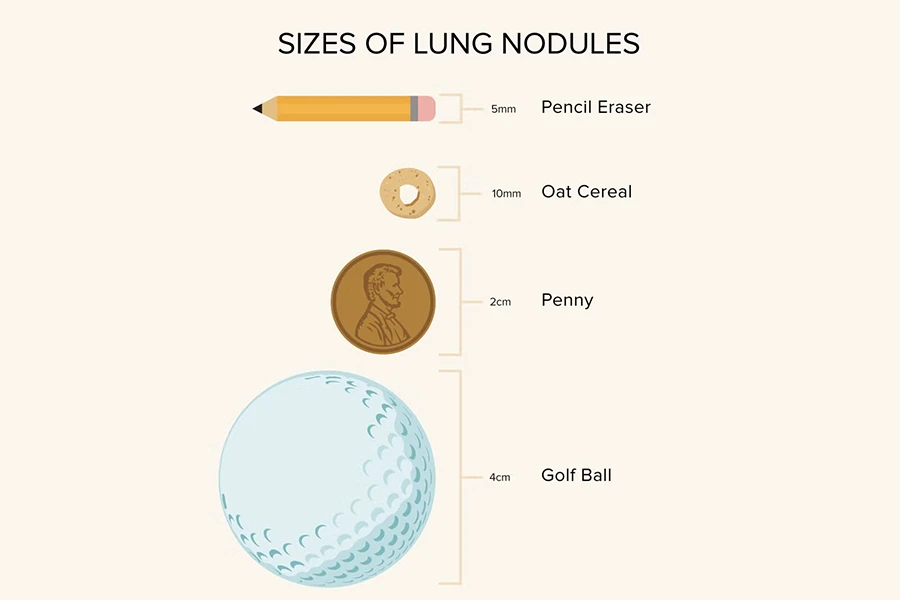
Size stands in for two things, how much tissue is sitting there and how long it has been growing. A 4mm lung nodule holds almost nothing. Even abnormal cells in that volume would need years to turn dangerous, which is why a long interval is safe.
The 8mm line matters because that’s where the math flips. Below it, the odds favor watching, and a repeat scan costs you nothing except time. Above it, the odds justify a faster answer through contrast imaging, a PET/CT, or a biopsy.
Shape carries weight alongside lung nodule size. Smooth, round edges point toward something benign, while strands radiating outward, called spiculation, raise concern. Calcium inside a nodule is reassuring too, since central, laminar, or popcorn calcification patterns are reliable evidence of a healed granuloma.
Location adds one more signal to the read. Nodules in the upper lobes carry a higher association with cancer than those lower down, though it’s only a tendency. Plenty of upper-lobe nodules are benign, and plenty of lower-lobe ones still need watching.
Your own risk profile shifts every threshold. Smoking history moves you into the higher-risk column, and so do radon exposure, older age, or a cancer you have already had. The same 5mm nodule then earns a closer look than it otherwise would.
Our guide to benign and cancerous pulmonary nodules covers what a nodule is and what causes one.
What Sets Your Follow-Up Schedule
Most radiologists in the United States follow the Fleischner Society 2017 guidelines for nodules found by accident on a chest or abdominal CT. The guidelines sort recommendations by four things, and size is only the first of them. Each one can pull your interval shorter or push it longer.
- Nodule size, measured as the mean diameter rather than the longest edge.
- Density, which separates solid nodules from the fainter ground-glass and part-solid kind.
- Count, since a single nodule and a scattered handful get managed differently.
- Your personal cancer risk, which is what splits the two columns below.
| Solid nodule | Lower-risk patient | Higher-risk patient |
|---|---|---|
| Single, under 6mm | No routine follow-up | Optional CT at 12 months |
| Single, 6mm to 8mm | CT at 6 to 12 months, then consider 18 to 24 months | CT at 6 to 12 months, then CT at 18 to 24 months |
| Single, over 8mm | Consider CT at 3 months, PET/CT, or tissue sampling | Consider CT at 3 months, PET/CT, or tissue sampling |
| Multiple, under 6mm | No routine follow-up | Optional CT at 12 months |
| Multiple, 6mm to 8mm | CT at 3 to 6 months, then consider 18 to 24 months | CT at 3 to 6 months, then CT at 18 to 24 months |
Adapted from the Fleischner Society 2017 recommendations for incidentally detected nodules. These guidelines don’t apply to patients under 35, to anyone with a known cancer elsewhere in the body, or to nodules found inside a formal lung cancer screening program.
Ground-glass nodules follow a different clock. These fainter, hazier spots under 6mm need no routine follow-up, while larger ones get a CT at 6 to 12 months to confirm they persist. After that, scans continue every two years out to five years.
Part-solid nodules, which mix a hazy area with a denser core, get a tighter leash. Anything over 6mm earns a CT at 3 to 6 months to confirm it’s still there. If the solid part stays under 6mm, annual scans run for five years.
The screening exclusion in that note matters more than it looks. Nodules found inside a screening program get graded on a separate system called Lung-RADS, published by the American College of Radiology. Ask which framework produced your recommendation, because the intervals differ between them.
Why the Next Scan Might Report a Different Number
Hand the same 7mm lung nodule to two radiologists and you can get two numbers back. In one study of nodules 20mm and under, readings varied by as much as 1.73mm between readers. One radiologist measuring the same nodule twice varied by 1.32mm.
Guidelines are built around that wobble. The Fleischner Society tells radiologists not to call it growth until a nodule changes by 2mm or more. Below that line you are reading the caliper rather than the nodule, so 5mm becoming 6mm rarely means anything happened.
How they measure matters too. Radiologists average the long axis with the short axis that crosses it, a figure called mean diameter. Averaging follows the real volume better than one line drawn across the widest point, and everything gets rounded to the nearest millimeter.
Consistency between scans is what makes comparison possible. Same technique, same slice thickness, and ideally the same scanner give your radiologist a clean before-and-after. Our guide to lung CT accuracy covers what the scanner can and can’t resolve at these sizes.
What Your Follow-Up Appointment Involves
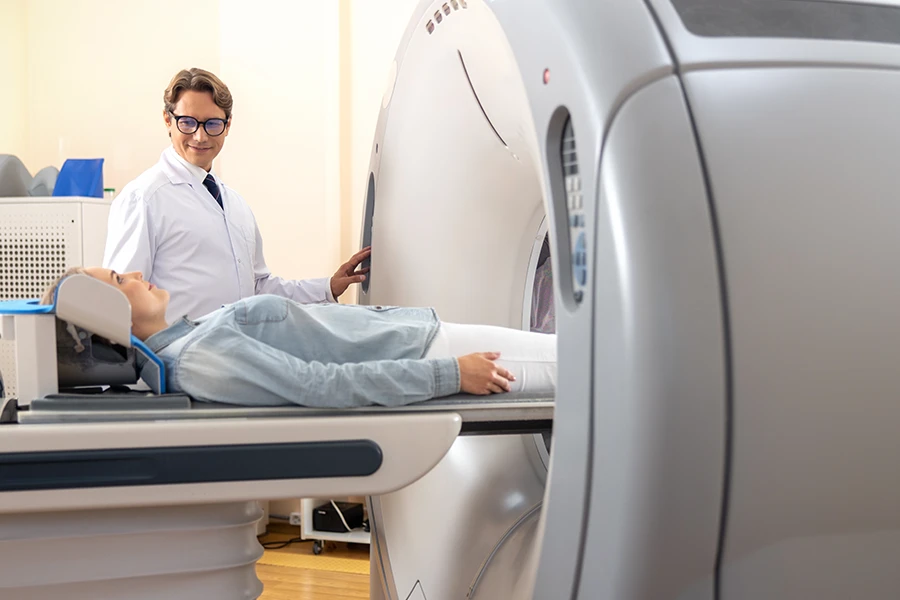
A surveillance scan is short. You lie on the table, hold your breath for a few seconds, and the scanner captures the images. There’s no contrast dye for a standard low-dose chest CT, no needles, and no recovery time afterward.
Radiation stays low by design. Follow-up imaging for nodules uses a low-dose technique that the literature caps at no more than 3 mGy. That’s the same approach behind screening CT, and it’s why repeat imaging is considered reasonable for people at raised risk.
Your follow-up report will not read like the first one. The radiologist works from both scans laid side by side, answering a single question about whether anything moved at all. Most people get the same answer, which is that nothing did.
At Craft Body Scan, board-certified radiologists read every scan, and you can book without a physician’s referral. If your nodule turned up on an outside scan and you need the follow-up study, a lung CT covers the chest on its own.
| Scan | Price | When it fits |
|---|---|---|
| Couples Heart & Lung Scan | $149 | Two people scanning together, both present the same day. Ages 40 and up, with a 35 to 39 option |
| Heart Scan | $640 | Coronary calcium scoring, ages 30 and up. Separate from nodule follow-up |
| Presidential Body Scan | $3,265 | The widest CT package, ages 30 and up |
| Full Body Scan | $2,495 | Chest, abdomen, and pelvis with bone density, ages 40 and up |
Pricing and age minimums verified against the Craft Body Scan booking system, August 2026.
Every scan and what it costs sits on the full pricing page. When you are ready, schedule a service at the location nearest you.
Answers to Common Questions About Lung Nodule Size
Is a 4mm lung nodule serious?
Rarely. At 4mm a solid lung nodule sits in the lowest band, where average cancer risk holds under 1 percent even in high-risk patients. Most people are sent home with nothing scheduled, though smokers are sometimes offered a scan at 12 months.
Is a 6mm lung nodule serious?
At 6mm you cross into the band where guidelines want another look. Average cancer risk through 6mm to 8mm runs somewhere around 0.5 to 2 percent. Expect a CT at 6 to 12 months, then usually one more at 18 to 24 if nothing has changed.
Is a 10mm lung nodule serious?
This one moves faster. The NELSON screening study put malignancy at 15.2 percent for nodules over 10mm, which is past the point where most doctors keep watching. Depending on the shape and your history, expect a CT at 3 months, a PET/CT, or a biopsy.
What size lung nodule is considered large?
For solid lung nodules the working line is 8mm. Cross 30mm and the word itself changes, since radiologists call that a mass. What makes 8mm the hinge is how fast risk climbs above it, which tips the plan from watching to investigating.
How much does a lung nodule have to grow before it matters?
At least 2mm. The Fleischner Society set that bar because measurements drift by more than a millimeter between readers. A 5mm lung nodule reported as 6mm usually means someone else held the calipers.
Can a lung nodule go away on its own?
Yes, and more often than people expect. Anything born of infection or inflammation tends to shrink or vanish once the cause clears. A lung nodule that disappears has answered the question outright, which is much of what the first follow-up scan is for.
What does a ground-glass nodule mean?
Ground-glass lung nodules look hazier on the image because they are less dense, and they run on their own schedule. Under 6mm, nothing routine is needed. Larger ones get a CT at 6 to 12 months, then a scan every two years out to five.
Does the lung nodule size chart apply if my nodule was found on a screening scan?
Not directly. The Fleischner intervals cover nodules found incidentally on a CT ordered for another reason. Nodules found inside a formal screening program are graded with Lung-RADS instead, so check which system your report used.
Booking the Scan That Settles It
The waiting period is the hardest part of a nodule finding, and it’s also the part doing the medical work. A follow-up scan converts an unknown lung nodule into a measured trend, and for the overwhelming majority of people that trend stays flat.
Get the follow-up scan
Turn the number in your report into an answer
Craft Body Scan performs low-dose chest CT at scan centers across seven states, with board-certified radiologists reading every study and no referral required. Bring your prior images so the comparison is direct.