

If you just heard the word “tumor,” or read “mass” or “nodule” on an imaging report, the question of benign vs malignant is probably the first thing on your mind. Here’s the short answer. A benign tumor is not cancer, and a malignant tumor is cancer. The opposite of a benign tumor is a malignant tumor.
The real difference comes down to spread. A benign tumor does not tend to spread to other parts of the body, although it can keep growing where it is. Malignant tumors can invade nearby tissue and travel through the blood and lymph system. Scans show that a growth is there, but in most cases a biopsy is what settles which kind it is.
Note: This article is meant simply for educational purposes. It should not act as a substitute for advice from a medical professional. Contact Craft Body Scan to speak with a medical professional or to learn more about body scans.
| Feature | Benign tumor | Malignant tumor |
|---|---|---|
| Is it cancer? | No | Yes |
| Growth | Tends to grow slowly | Usually grows quickly, though some grow slowly |
| Spread | Stays in one place | Can invade nearby tissue and spread through the blood and lymph system |
| Cells under a microscope | Look similar to normal cells | Usually look abnormal |
| Borders | Well defined | Often irregular |
| After removal | Usually does not grow back | Sometimes grows back |
| Common treatment | Often surgery, or watching and rechecking | Often a combination, such as surgery with chemotherapy and radiation |
What Benign and Malignant Actually Mean
Benign means not cancer. Benign tumors may grow larger, but they do not spread to other parts of the body. A malignant tumor is a tumor made of cancer cells, which grow in an uncontrolled way and can invade nearby tissue. Put simply, malignant means cancer cells are present.
The National Cancer Institute (NCI) defines a tumor as an abnormal mass of tissue. A tumor forms when cells grow and divide more than they should or do not die when they should. Neoplasm is another name for the same thing. Either one may be benign or malignant, so the word tumor alone does not tell you which kind it is.
Your imaging report may use other words. A mass is a lump in the body that can come from abnormal cell growth, a cyst, hormonal changes or an immune reaction, and it may be benign or malignant. Lesion is broader, covering any area of abnormal or damaged tissue. If your report mentions a cyst, our guide to how imaging tells a cyst from a solid tumor covers that question.
How Benign vs Malignant Tumors Behave Differently
Spread is the dividing line in any benign vs malignant comparison. A tumor is malignant when its abnormal cells can invade surrounding tissue and spread to other parts of the body, and benign when they cannot. NCI’s explainer on what cancer is describes how cancerous tumors invade nearby tissue and can travel to distant places in the body to form new tumors, a process called metastasis.
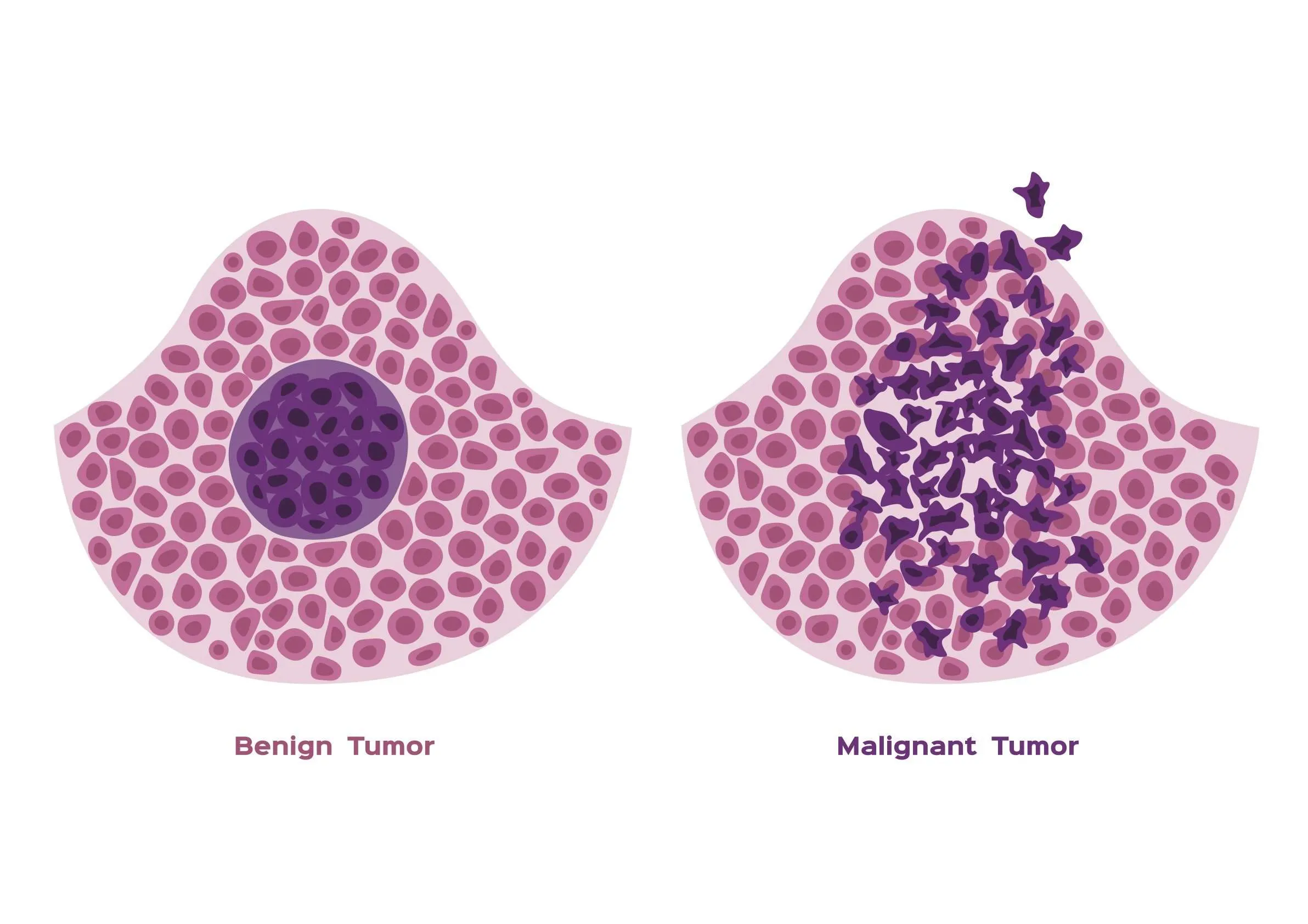
Cancer that spreads is still named for the place where it started. Breast cancer that reaches the lungs is still breast cancer, and the cells found in the lung are breast cancer cells. Spread is also why malignant tumors carry more weight. Metastatic tumors can badly damage how the body functions, and NCI reports that most people who die of cancer die of metastatic disease.
Growth speed and cell appearance tend to follow the same split, though these general features can vary with tumor type. A benign tumor tends to grow slowly and is usually contained to one area. Most malignant tumors grow quickly, although some grow relatively slowly. Under a microscope, benign cells look similar to normal cells, while malignant cells usually look abnormal and often have irregular borders.
Removal tells another part of the story. Benign tumors usually don’t grow back once removed, whereas cancerous tumors sometimes do. Spread itself can take more than one route. A malignant tumor can grow directly into neighboring organs or tissues, or reach distant sites through the bloodstream, the lymphatic system or seeding in body cavities.
When a Benign Tumor Still Causes Problems
Benign tumors can still cause real problems. According to the American Cancer Society’s overview of neoplasms and tumors, they can sometimes grow quite large or press on organs, nerves or blood vessels. In those cases, they can be serious and might need removal. NCI names benign tumors in the brain as an example of growths that can cause serious symptoms or be life threatening.
Meningioma shows why a label needs context. The American Cancer Society (ACS) lists it as a benign growth in the layers of the brain and spinal cord, often removed because it can press on those structures. The most common type, grade I, is slow growing. Grade II and III meningiomas are rare, but they grow quickly and are likely to spread within the brain and spinal cord.
Hormones are another way a benign tumor can cause trouble. Pheochromocytomas, adrenal tumors that make too much adrenaline, are usually benign but can cause high blood pressure, pounding headaches and heart palpitations. Most pituitary tumors are benign and many cause no symptoms at all. When they do, the symptoms depend on which hormones the tumor affects.
Plenty of benign tumors stay quiet. Uterine fibroids, benign smooth muscle tumors, are the most common benign tumors in women of childbearing age, and they often cause no symptoms. Our guide to fibroid imaging and what the results mean covers how they are found. Lipomas, made of fat cells, are another familiar benign growth, and so are moles, which are clusters of the skin’s pigment cells.
Can a Benign Tumor Become Malignant?
Some can, and the category that sits between the two explains how. Precancerous, also called premalignant, describes a condition that may, or is likely to, become cancer. Precancerous cells are abnormal but not cancer, and they show changes that raise the risk of turning into cancer over time. They cannot spread the way cancer cells do.
Colon polyps are the clearest example. Most colon and rectal polyps are benign, but some types can change into cancer, usually over many years. The chance depends on the type of polyp. Adenomatous polyps, or adenomas, sometimes change into cancer, so they are called a precancerous condition.
Two other terms sit close to this line. Dysplasia means abnormal cells that are not cancer but may sometimes become cancer, and it is graded mild, moderate or severe. NCI says carcinoma in situ, sometimes called stage 0 cancer, is not cancer because its cells do not invade nearby tissue. Because some may become cancer, it is usually treated.
This is where timing works in your favor. ACS notes that the process of becoming cancer can take many years, and that early detection and treatment of precancers can prevent cancer from developing. Not every precancer turns into cancer. Precancers are still warning signs, and ideally they are removed when they are found or shortly after.
How Doctors Tell Benign From Malignant
There is no single test that can diagnose cancer, according to NCI’s guide to the tests used to diagnose cancer. Imaging creates pictures that help a doctor see whether a tumor is present. A CT or MRI scan can also show exactly where it is and how far it has spread. These pictures help narrow down benign vs malignant.
Imaging has limits, and the American Cancer Society’s page on imaging tests notes that sometimes imaging alone cannot show for sure whether a change is caused by cancer. The images are read by a radiologist, a doctor who specializes in imaging, who sends a report to your health care team. A board-certified radiologist holds certification from the American Board of Radiology or the American Osteopathic Board of Radiology.
Lung nodules show what a radiologist weighs. RadiologyInfo.org, from the American College of Radiology and RSNA, says most lung nodules are benign and some may be early-stage cancer. For a lung nodule, size, growth and shape all change the likelihood of cancer, and these points do not apply to every tumor. If a nodule hasn’t grown or changed over a few years, it can usually be left alone.
Other scans offer their own clues. How a tumor absorbs MRI contrast dye over time can tell doctors whether it is more likely benign or malignant. Even so, MRI is usually combined with other tests, such as a biopsy, to confirm a cancer diagnosis.
That is why the biopsy usually settles the question. In most cases, doctors need a biopsy to be certain of cancer. A doctor removes a sample of the abnormal tissue, and a pathologist, a doctor trained to identify disease by studying cells and tissue, examines it under a microscope. The pathology report gives a diagnosis for each sample and is used to help manage your care.
Treatment and Outlook for Each Type
Whether a tumor comes out depends on its size, location, type and whether it is benign or malignant. Some benign tumors need removal. Others can be left alone or watched. Treatment may not be needed at all when a benign tumor sits in a safe area where it causes no symptoms or organ problems.
When a benign tumor does need treatment, it often involves surgery. Some are removed to improve symptoms or for cosmetic reasons, and those in or near the brain may be removed because of their effect on the brain. The outlook for a benign tumor is generally very good, although benign brain and spinal cord tumors may come back.
After a cancer diagnosis, more testing follows. Further tests identify the exact type of cancer cells and the cancer’s stage. Most people then receive a combination of treatments, such as surgery with chemotherapy and radiation therapy, and targeted therapy and immunotherapy are other options. The outlook depends on the type and stage of the cancer at diagnosis, and some cancers can be cured.
Early Detection and Preventive Screening at Craft Body Scan
Screening means checking for disease when there are no symptoms. The NCI overview of cancer screening says screening tests can help find cancer early, and that abnormal tissue or cancer found early may be easier to treat or cure. Used this way, imaging looks for cancer while it is still small, has not spread and has caused no symptoms.
If part of you would rather not know, the trade-offs are worth hearing plainly. The same NCI overview is frank that not all screening tests are helpful and most have risks. A false positive can cause anxiety and lead to more tests. A result can also look normal when cancer is present, and screening can find cancers that would never have caused symptoms, which is called overdiagnosis.
Sometimes an imaging test shows something that looks like cancer, and a biopsy or further testing shows it is not. Every screening test has benefits and harms. The choice is best made with your health care provider. Our list of standard cancer screening tests and how often to have them is a good place to start that conversation.
Our full body scan is a low-dose CT scan of the heart, lungs and abdomen in one visit. It includes a coronary artery scan, a chest scan and an abdomen and pelvis scan. We have a board-certified radiologist review every scan, examining organs such as the liver, pancreas and kidneys for tumors, anatomical abnormalities and other signs of disease. The low-dose CT does emit some radiation.
We offer the scan as preventive care for people without symptoms, and it never replaces follow-up care. A scan alone usually cannot settle benign vs malignant. If your scan shows an abnormal finding, we recommend taking the results to your primary care provider promptly for further testing and referrals. When you’re ready to look for changes early, see how preventive cancer screening at Craft Body Scan works.
Book Your Preventive Cancer Screening
Screening is for people without symptoms and looks for changes while they may be easier to treat. A board-certified radiologist reviews every scan we perform for early signs of cancer.
Schedule My ScreeningCommon Questions About Benign vs Malignant Tumors
Does benign mean no cancer?
Yes. A benign tumor is not cancer. The tumor may keep growing in size, but its cells will not invade other unrelated tissues or organs. Some benign growths, such as adenomatous colon polyps, are also precancerous, so a doctor may still recommend removing or watching one.
Does malignant always mean cancer?
Yes. Malignant is the term used to describe cancer. A malignant tumor has cancer cells, which grow in an uncontrolled way and can invade nearby areas and spread to other parts of the body. Normal cells, by contrast, stop growing when they meet other cells, and most of them do not move around the body.
Is a malignant tumor the same as cancer?
A malignant tumor is a cancer, but not every cancer forms a tumor. Many cancers form solid tumors, while blood cancers such as leukemias generally do not. That makes cancer the broader word. Among solid tumor cancers, the most common are breast, prostate, lung and colorectal cancers.
Is a malignant tumor fatal?
Not necessarily. ACS says the seriousness of a malignant tumor depends on the type of cancer cells in it, along with its location and size. Whether it has spread and how it affects the person’s health matter too. For what a specific diagnosis means for you, your care team is the right source to ask.
Is a malignant tumor curable?
Some are. The outcome depends on the type and stage of the cancer at diagnosis. Doctors ideally aim to get rid of a malignancy completely, ACS explains, and in some cases surgery removes all of it. In other cases, only part of the cancer can be removed.
What are some common benign tumor examples?
A hemangioma is a benign cluster of blood vessels that forms a reddish or purplish lump, commonly on the skin. Fibromas, benign growths of fibrous tissue, turn up mostly in the skin or lungs. An adenoma is a benign growth in glandular tissue, usually in the thyroid or colon, and may be called a nodule.
Why do so many tumor names end in “-oma”?
Names of benign tumors usually end in “-oma,” such as adenoma for a gland tumor and osteoma for a bone tumor. Their malignant counterparts are adenocarcinoma and osteosarcoma. The rule is not reliable on its own. Lymphoma, melanoma and multiple myeloma all end the same way, and all three are cancers.
What is the difference between a radiologist and a pathologist?
A radiologist is the doctor who reads your medical images, and a pathologist is the doctor who studies cells and tissue under a microscope. A radiologist has completed a radiology training program of at least four years. When a referring doctor says they reviewed your scan, they usually mean they reviewed the radiologist’s report or went over the exam with the radiologist.