Medical disclaimer: This article is for informational purposes only and does not constitute medical advice. Speak with a licensed physician before beginning any peptide protocol. Craft Body Scan’s imaging services provide baseline health data – they are screening tools, not diagnostic instruments for cancer.
Search BPC 157 side effects and the boring stuff shows up first. People mention nausea after an injection, a dizzy spell at the gym, skin irritation near the needle site, or a headache that fades by morning. Those complaints count. Physicians slow the conversation down for a different reason.
The harder question sits underneath the recovery claims. In preclinical research, BPC-157 appears to push blood-vessel growth. Injured tissue can use that signal to heal, and an existing tumor can use related biology to build blood supply.
That distinction changes the decision. Current evidence does not show BPC-157 causing cancer. What gives us pause is a quieter scenario, an early cancer already present and too small to cause symptoms.
Most articles flatten that point into a warning label. We take a more careful route. Before a BPC-157 cycle, especially after 40, bring this mechanism into the visit with your physician.
The Short Answer
So far, the evidence does not show BPC-157 causing cancer. We pause because preclinical studies tie it to angiogenic signaling, including VEGFR2 activity. Tumors also use angiogenesis to build blood supply. In a patient with an undetected malignancy, that overlap gives physicians a reason to pause before peptide use.
What BPC 157 Side Effects Mean Before You Start

You will see BPC expanded as Body Protection Compound. Chemically, it is a synthetic pentadecapeptide related to a sequence found in gastric juice. The research interest keeps returning because animal models show repair activity in tendons, muscle, gut tissue, nerves, and blood vessels.
That explains its pull in recovery circles. In the biohacking community’s approach to longevity, BPC-157 is used less as a performance drug and more as a repair signal. The wolverine stack pairs it with TB-500 because the compounds affect overlapping repair pathways.
The human evidence is still thin. A 2025 review described strong animal-model interest and only a small human pilot record. FDA approval has not been granted for BPC-157 as a drug. The agency also lists compounded BPC-157 among bulk substances with potential safety risks because route-specific safety data remains limited.
That matters for any discussion of BPC 157 side effects. Users can usually recognize short-term complaints. Long-term safety in humans is a different category, and that file is not closed. We treat BPC 157 side effects as a medical screening conversation.
The VEGF and VEGFR2 Pathway Behind the Cancer Concern
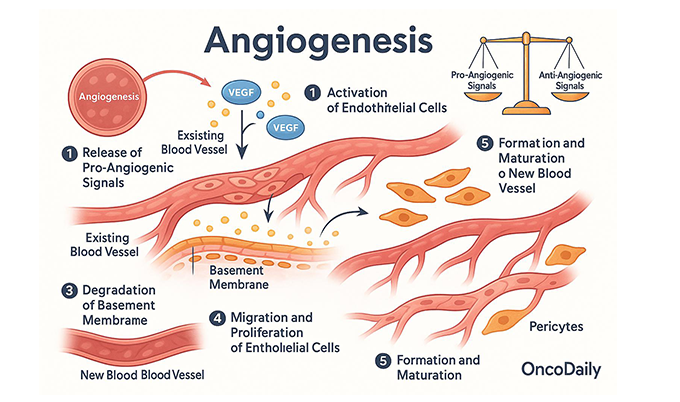
VEGF is the shorthand for vascular endothelial growth factor. During angiogenesis, your body uses that signal to form new blood vessels. Damaged tissue needs oxygen and nutrients, which is why new vessel growth can speed repair.
BPC-157 appears to work through that system. In a 2017 Journal of Molecular Medicine study, treated models showed more vessel density and higher VEGFR2 expression in rat hind-limb tissue. The researchers also reported VEGFR2 activation in human vascular endothelial cells.
So the cancer concern is not vague. VEGFR2 is a core angiogenesis receptor. The VEGF/VEGFR2 axis is also active in many solid tumors, including colorectal, prostate, Lung cancer, breast, and pancreatic cancers.
Oncology often approaches the pathway from the other side. Anti-VEGF and anti-VEGFR drugs exist because cutting off a tumor’s blood supply can slow some cancers. BPC-157 research looks at pro-angiogenic repair, so the signal moves toward vessel formation.
We frame the BPC-157 cancer risk around an existing abnormal growth rather than normal cells suddenly turning malignant. The concern, drawn from the broader tumor angiogenesis literature, is narrow. An early tumor may depend on angiogenesis before it can grow beyond a small local cluster.
If you’re running a BPC-157 protocol while an early malignancy is present and silent, you may be adding signal to a pathway that tumor biology can use. We can’t say that will happen at common peptide doses. We can say the mechanism gives the question real weight.
The survival difference is why timing matters. SEER reports 91.3% 5-year relative survival for localized colorectal cancer and 16.9% after distant spread. Early detection data from the National Cancer Institute supports the same practical point across colorectal screening. Stage at detection changes the options in front of the patient, which is why BPC 157 side effects need a baseline discussion.
Who Faces Higher Risk From BPC 157 Side Effects
The VEGF concern is uneven. BPC 157 side effects do not carry the same meaning for every patient, because risk depends on the chance that an undetected malignancy is already present. Age, sex, family history, smoking history, prior cancer, and missed screening all change that probability.
Men over 40 who have never had preventive imaging deserve extra caution. Prostate, colorectal, and lung cancers can develop through silent phases, and the typical peptide user often fits that age band. That does not make BPC-157 uniquely dangerous. It makes baseline information more useful before exposure to an angiogenic compound.
| Profile | VEGF Risk Level | Key Concern | Recommended Action |
|---|---|---|---|
| Men 40+ with no recent imaging | Higher | Prostate, colorectal, and lung cancers can be present without symptoms | Discuss baseline imaging before a first cycle |
| Family history of cancer | Higher | Inherited risk can raise the odds of an early malignancy | Review family history with a physician before use |
| Prior cancer diagnosis | Raised | Angiogenic signaling may conflict with oncology history | Consult your oncologist before use |
| Smokers or former smokers | Raised | Lung cancer risk may already meet USPSTF screening criteria | Follow LDCT screening guidance before peptide use |
| Men under 40, no family history | Lower | Baseline incidence is lower, though early cancers still occur | Review personal risk before deciding |
| Currently undergoing cancer treatment | Contraindicated | Angiogenic signaling may conflict with treatment goals | Do not use without oncology approval |
The Wolverine Stack and BPC 157 Side Effects
BPC157 TB500 combinations keep showing up in recovery forums because the pairing has a simple logic. BPC-157 brings the VEGFR2 and angiogenic repair discussion. TB-500 connects to thymosin beta-4, which researchers have studied in cell migration, wound healing, angiogenesis, and certain tumor-biology models.
Human safety data on the combined wolverine stack is missing. Each compound has been studied on its own far more than the stack has been studied as a real-world protocol. That leaves physicians with mechanism, animal data, and caution.
Adding TB-500 does not answer the BPC-157 cancer question. It adds another repair-oriented signal with its own angiogenesis literature. The stack is not expected to give a healthy person cancer. The baseline question still carries more weight.
The practical starting point stays the same. BPC 157 side effects are easier to weigh when you know what is already in your body before adding compounds that may influence vascular growth.
What Radiologists Check Before Peptide Therapy
The biohacking community on Reddit and X has been circling the right idea. That conversation includes PSA levels checked and tracked for men over 40, bloodwork before cycles, and baseline imaging before compounds that touch growth pathways.
Bloodwork helps, but it has limits. Many early solid tumors do not produce a reliable blood marker. Imaging can show organ, tissue, vascular, and lung findings that a routine lab panel may miss.
A full-body scan can give a broad internal baseline before a peptide cycle. Men over 40 with smoking or cardiac risk history often need more context from a heart and lung scan. USPSTF lung guidance calls for annual low-dose CT in adults ages 50 to 80 with a 20 pack-year history who currently smoke or quit within 15 years.
For men with higher PSA values or prostate cancer in the family, prostate evaluation belongs in the conversation. For colorectal risk, including family history, age over 45, or prior polyps, virtual colonoscopy screening may belong in the baseline plan. The goal is not to find a reason to avoid peptides. The goal is to lower the uncertainty that angiogenic biology creates.
A clear scan does not make BPC-157 risk-free. It changes the discussion because you are no longer guessing about the main hidden variable.
Before Your First BPC-157 Cycle – What an Informed Biohacker Checks
- Baseline cancer screening – BPC 157 side effects need context, and imaging can look for findings that deserve follow-up before a VEGF-linked protocol
- PSA level (men 40+) – prostate-specific antigen gives you a reference point before and after cycles
- Heart and lung imaging – smoking history, cardiac risk factors, and vascular concerns can change the screening plan
- Family history documentation – first-degree relatives with cancer before age 60 should push the conversation toward physician review
- Source verification – FDA notes potential risks with compounded BPC-157, including immunogenicity and peptide impurity concerns
- Physician review – a clinician who understands your history should review the protocol before you start
Frequently Asked Questions About BPC-157 Side Effects and Cancer Risk
Can BPC-157 Trigger Cancer Cell Growth?
We did not find evidence that BPC-157 turns normal cells into cancer cells. The concern stays with angiogenesis. Preclinical studies report pro-angiogenic activity and VEGFR2 activation. Tumors can use angiogenesis to build blood supply. The same mechanism matters more when an undetected malignancy is already present, though human dose-level risk remains unsettled.
What Peptides Should I Avoid If I Have a Family History of Cancer?
Any compound tied to angiogenesis deserves physician review when cancer risk is higher. BPC-157 and TB-500 belong in that discussion because of their repair and vessel-growth literature. Family history does not automatically rule them out. It does support establishing a clear baseline with imaging before use, especially when first-degree relatives had cancer at younger ages.
Is It Safe to Use BPC-157 Every Day?
Daily protocols in biohacking circles are not built from large randomized human trials. Short-term BPC 157 side effects may be mild for many users, but the long-term safety profile remains unsettled. Repeated cycles raise a different question than a single short course because the angiogenic signal may last across more exposure time.
How Does BPC-157 Interact With VEGF Receptors?
Preclinical research shows BPC-157 can activate and increase VEGFR2 signaling in vascular endothelial cells. VEGFR2 plays a major role in angiogenesis. That pathway explains much of the tissue-repair interest in BPC-157 and why cancer-risk discussions keep returning to it.
Should I Get an MRI or Body Scan Before Starting Peptide Therapy?
If you are over 40, have a family history of cancer, smoke or formerly smoked, or have gone several years without preventive imaging, ask your physician about baseline imaging. A scan cannot guarantee that no cancer exists. It can give you information a blood panel may miss. Craft Body Scan offers early detection screening services reviewed by board-certified radiologists, with no referral required.
Know Your Baseline Before You Inject
BPC-157 is a research peptide with real preclinical repair data and unresolved human safety questions. Common BPC 157 side effects are usually manageable. The cancer-related concern sits in the angiogenesis pathway rather than the nausea or injection-site irritation people mention first.
We don’t view baseline screening as fear-based medicine. We view it as adult decision-making. If you are going to use a compound that may promote blood vessel growth, you should know whether anything suspicious is already present.
An early detection approach to your cardiovascular and organ health can fit with biohacking for longevity. Craft Body Scan provides private-pay preventive imaging at clinics across Oklahoma, Texas, Florida, Tennessee, and Ohio, and board-certified radiologists review every scan. Results give you and your physician a clearer starting point before your first cycle.
Schedule Your Baseline Scan
Get a clear picture of your internal health before your first peptide cycle. Craft Body Scan’s board-certified radiologists review every scan personally. No physician referral is required, and private-pay pricing includes flexible options. Walk into your protocol with facts in hand.
Book Your Scan Today